
Yesterday’s SCOPE session “The Great Data-Capture Debate” delivered a masterclass in why clinical trial data capture remains broken—and how CRIO is uniquely positioned to fix it.
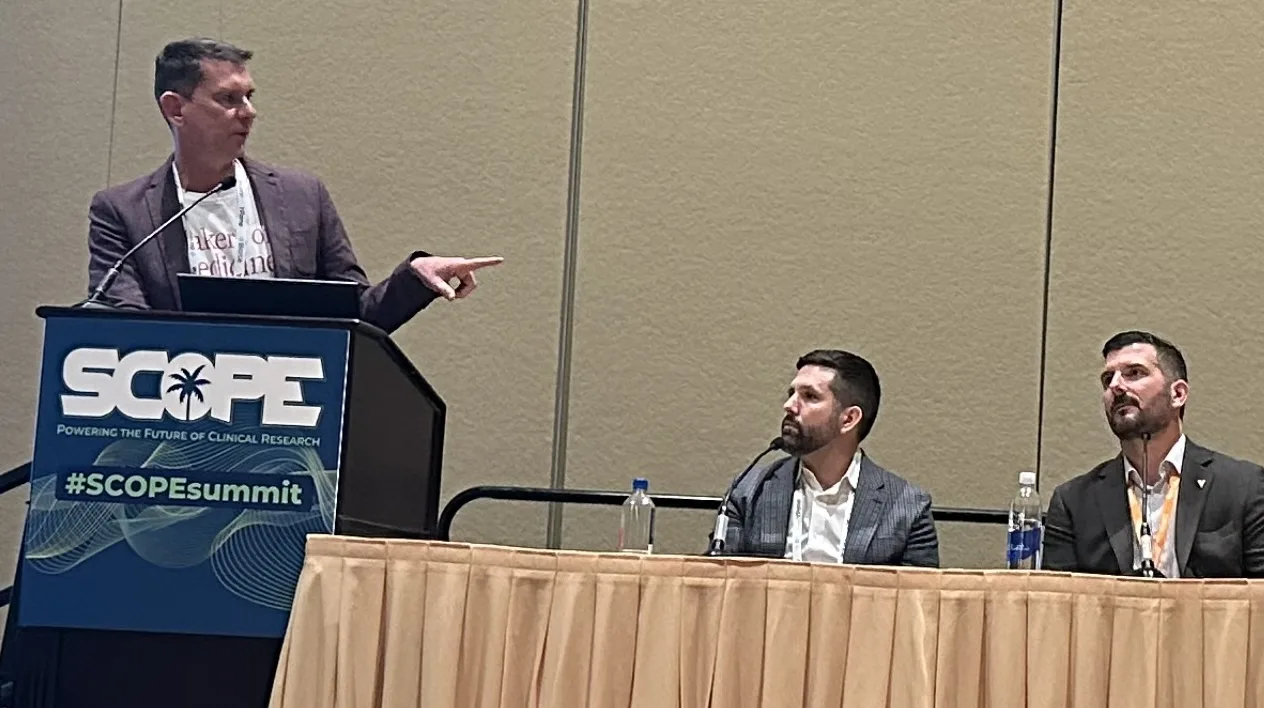
Chaired by Doug Bain with Mike Ward from Lilly moderating, the panel featuring Mike Wenger (CRIO), Derk Arts (Castor), Manny Vazquez (Veeva), and Zach Taft (Ignite Data) exposed hard truths about eSource adoption that most vendors won’t say out loud.
The Inconvenient Truth: One Size Does NOT Fit All
Mike Wenger opened with what should be industry common sense but somehow isn’t: “Not all sites are created equal.”
There are two fundamentally different eSource models:
EHR-Based eSource: Large academic medical centers and hospitals with multimillion dollar Epic/Cerner installations doing clinical research alongside standard of care.
Protocol-Driven eSource (CRIO’s model): Dedicated research centers, IROs, site networks, and many community-based physician practices and healthy systems—representing ~80% of clinical trial sites—that don’t have EHRs and need purpose-built research tools.
Yet the industry keeps trying to force a single approach. As Zach Taft bluntly stated: “The idea of putting an eSource platform on top of a billion-dollar Epic installation is idiocy.” The reverse is equally true: forcing EHR-dependent solutions on sites without EHRs is a non-starter.
Why CRIO’s Model Works: Site-First Technology
The panel consensus was clear: sites need tools they choose, not systems sponsors impose.
Manny Vasquez reinforced this: “80% of sites are small community centers without EHR infrastructure. The eSource or whatever tool they’re using has to live within their standard day-to-day operations and be a core tool they use.”
That’s exactly CRIO’s model:
 Sites choose CRIO for their operations across all studies
 Protocol-driven customization means every study gets purpose-built forms
Integrated CTMS + eSource + regulatory binders = single platform for site workflows
Works with major pharma/CRO partners including Eli Lilly, and other top 20 pharma and top 5 CROs
Eliminates the swivel chair through integrations with major EDC providers.
The Integration Imperative
Every panelist agreed: the biggest bottleneck isn’t technology—it’s manual transcription from eSource into sponsor EDCs. As Mike explained: “Picture a person sitting at a desk with one system on the left and one system on the right, copying and pasting values for hours and hours, all day, every day.”
This is why CRIO’s partnership approach matters. As Zach Taft emphasized: “Partnerships in this industry are how this is going to work. Partnerships like Ignite and CRIO working together allow for this kind of acceleration.”
The Path Forward: Choice + Integration + Partnerships
The session conclusion was clear: there’s no one-size-fits-all solution. Sites need choice. Different models serve different site types.
For the 80% of sites without EHRs – the independent research centers, SMOs, and site networks conducting the majority of clinical trials – protocol-driven eSource like CRIO is the answer.
For the 20% of sites with EHR installations doing research alongside care, EHR-based approaches make sense.
The future isn’t about picking winners – it’s about seamless integration between whatever eSource model sites choose and sponsor EDCs. CRIO is building that future with partners across the ecosystem.
Thank you to Doug Bain, Mike Ward, and fellow panelists for one of the most candid discussions on this topic I’ve experienced.
For sponsors: Want to eliminate the 30-80 hour site startup burden and swivel chair transcription? Let’s talk about how CRIO’s 2,500+ site network can accelerate your studies.
For sites: Already using CRIO? You’re ahead of the curve. Not using CRIO? Let’s discuss how we can transform your operations.